Tuesday, January 12, 2016

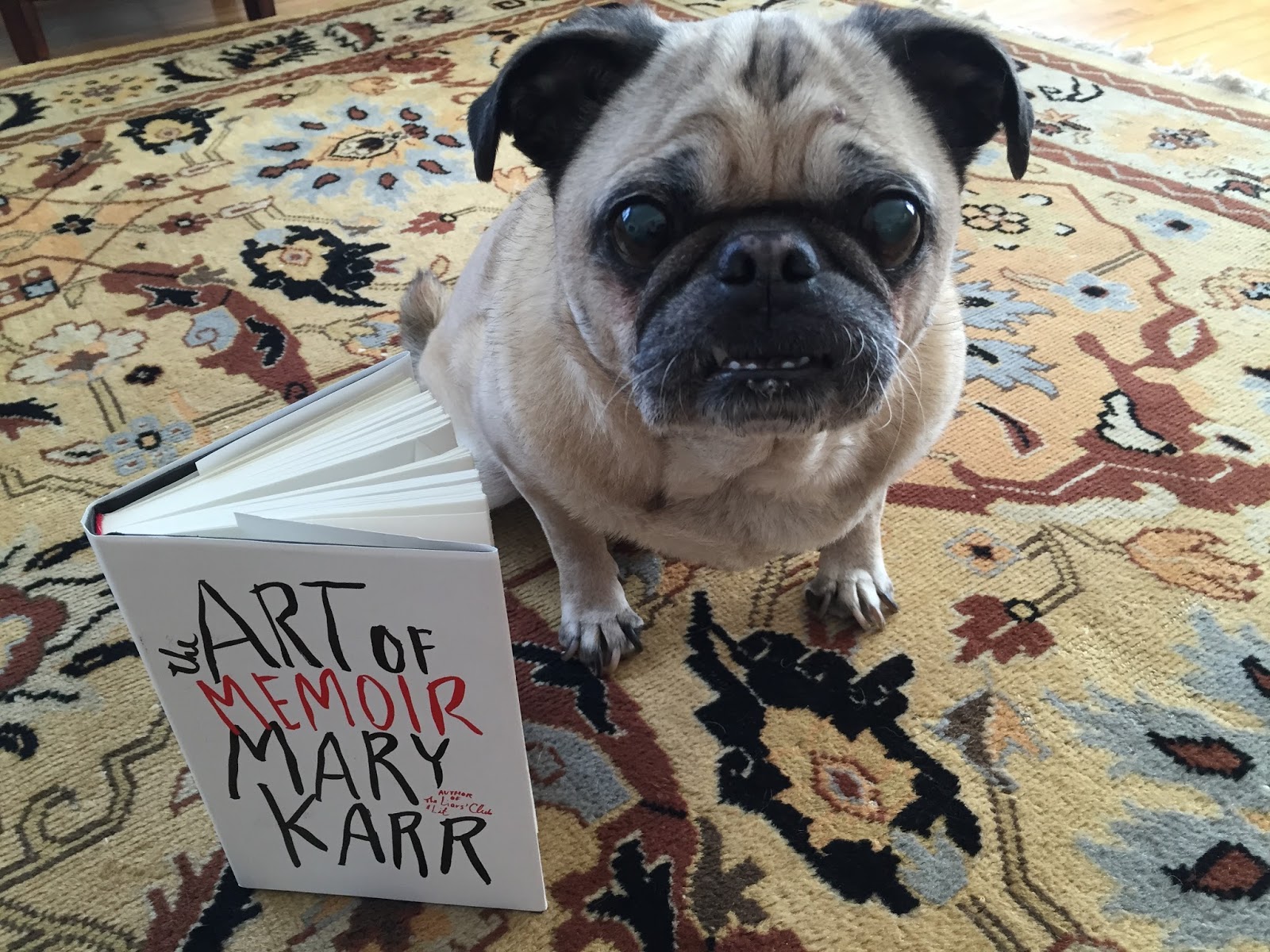
"The Art of Memoir": Why Our Stories Matter


"To bring oneself to others makes the whole planet less lonely.  The nobility of everybody trying boggles the mind." - Mary Karr

I've taken over a month off from my book blog.  I realized today that I miss writing, and opted to shirk the laundry piling up, the planning I need to do for my yoga classes, and the work that I need to complete for Stageoflife.com and to get back to writing.

I've read 5 books since I last posted, so there may be a deluge of book blog posts over the next 2 weeks.  Although I usually write my posts in the order I read books, I want to start with my favorite book that I read which was recommended to me by my best friend and one of our editors, "The Art of Memoir" by Mary Karr.

Oddly, I have never read any of Mary Karr's other books even though memoir is my favorite genre.  I owned "Lit" but gave it away right before we moved in Illinois. I remembered trying to start it once and not being able to get into it, so I carelessly tossed it into the "give away" box.  "The Liar's Club" was always on my list of "to reads" but I always found other memoirs to read before I purchased it.  After finishing her book "The Art of Memoir" and hearing her stories, being engaged by her voice, finding her vast knowledge of memoir writing awe inspiring, and feeling the tug to write more because of her book, I know that I need to read her memoirs to get to know her story even better.

As I often do before I post my own thoughts about a book, I check out what the "big guys" have to say about them.  "The Art of Memoir" received mixed reviews.  It made a few "best books of 2015" lists including Amazon's best book of September 2015, but it also got some reviews that called it "muddled" or "boring." In the New York Times Sunday Book Review, Gregory Cowels wrote, "It is not, alas, a very good book. Repetitive, unorganized, unsure of its audience or tone, it can’t decide whether it wants to be a how-to guide or a work of critical analysis." Yikes.  I agree with him that sometimes that book is messy, but so is life, right? Isn't that the strength of a good memoir, to make some sense out of the mess of life? Karr writes, "But I still feel awe for us - yes, for the masters who wrought lasting beauty from their hard lives, but for the rest of us, too, for the great courage all of us show in trying to wring some truth from the godawful mess of a single life." To me the mark of a good memoir is exactly that, and although I have never read a book about the art of writing memoirs, I do believe that Karr succeeds in finding truth in the process of writing about the truth of living messy lives.  

Drawing on her teaching syllabus, she weaves in and out of her own experiences of memoir writing and the craft of other well known memoir writers to explain what makes great memoirs great and what are the pitfalls of bad memoir writing.  She's not only funny, but she's also smart. Having three of her own best selling memoirs and having the prestige of a professorship at Syracuse University does not make her unapproachable.  Giving practical advice about how to deal with people that you write about in a memoir, and general rules of good writing (use sensory details - she calls them "carnal" details), Karr also includes a chapter called "Hucksters, the Deluded, and Big Fat Liars" basically saying when writers stretch the truth knowingly they suck.  It's way harder to strive to get the truth right and accurate because memories are tricky beasts.

The parts of the book that drew me in the most were Karr's own stories of writing attempts and failures as well as her victories.  She admits to not being the best writer, but being a "bull dog" of a revisionist searching for the best and most authentic details.  She discloses that she often had to write the wrong thing in order to clear the path to write the right thing.

What I loved best about this book is that it transcended writing memoirs and to me, was more about the search for our authentic selves.  When she asks questions like, "And most of all, how am I afraid of appearing? Go beyond looking bad or good. Is there posturing or self-consciousness you could duct or correct or confess and make use of?" These questions are about constructing identity, and revealing our authentic self by writing our truths in the best way that we can.  Why do people write? To tell the truth? To understand the truth? To get to the truth? Sometimes we need to write our past to make sense of what happened in order to be able to move on in the present. Sometimes we are lucky enough to connect with other people who benefit from our struggles - either the struggle of writing or the struggles that we lived to tell about in our stories.

This book isn't for everyone.  Some chapters delve heavily into to literary analysis of the memoir greats like Maxine Hong Kingston and Vladimir Nabokov.  The English teacher in me loved these chapters, but I can't see all readers enjoying them.  I, on the other hand, love people who are passionate about good writing and can see the craft of other writers as a gift.

My biggest take away after reading this book was to rekindle my writing self and to find my voice again on the page.  Sometimes I get so caught up in the minutia of life that I forget about this writer inside of me who wants to do more than just read books and post about them.  Karr helped me fall in love with writing again and see the beauty in the elusive craft of telling our stories authentically and truthfully.


Wednesday, December 9, 2015

"In a Dark Dark Wood": A Bachelorette Party Gone Awry


Looking for a gift for someone who loved the book 'Girl on the Train' by Paula Hawkins?  Ruth Ware's debut novel 'In a Dark Dark Wood' might be the best gift ever for someone who loves a fluffy thriller in the same vain as 'Gone Girl' and 'Girl on the Train.'

Ware's hen party (the UK name for bacholerette party) gone awry tale garnered rave reviews and even won a spot as Amazon's top book pick for August 2015.  It was a bestseller and received lots of book buzz as a summer 2015 best books pick.

The story centers around Nora (formerly known as Lee by her school friends) who reluctantly decides to attend a hen party for her ex- best friend Clare who she has neither seen or heard from in over a decade.  Because Nora's friend Nina also decides to go, Nora makes the creepy trek to the isolated glass house in the English countryside for a weekend of unknowns.  Why would Clare contact her out of the blue even though she didn't even receive a wedding invitation? Who else would be there? What exactly were they going to do for the entire weekend.

Nora likes her privacy choosing a life of writing and running and living in a tiny apartment alone in London.  She is unprepared for the catty behavior of the women and man invited to the hen and even less prepared to find out that Clare is marrying the love of Nora's life who she never really got over.

Told in alternating past and present chapters and narrated by Nora, this book is very quick, but it's also very odd.  Do grown women really behave like middle schoolers when thrown together in a big glass house? Ouija boards? Truth or Dare? Playing with guns? Scathing and bitchy comments towards each other? Maybe some people actually act like this and talk like this, but I am glad that I am not stuck in a big old glass house in the middle of a creepy forest with them for an entire weekend.

I guess there was some suspense and the mood was ultra dramatic as well with the house almost taking on a personality of it's own. The dark dark woods also add to the scare factor symbolizing both freedom for Nora when she goes for her runs to clear her mind and also the suffocating fears of the unanswered questions.

People seem to really like this book, so maybe it's just me.  I don't get the whole "psychotic women who have troubled pasts and harbor ill feelings that turn them into mental nightmares who are okay with gruesome killing" thing.  I also have an issue with reading books that don't have even one likable character.  It's hard to care if someone is fighting for their life or sanity when you don't care if they live or die.  And that's exactly how I felt during this book.

Maybe for some people the revelations throughout the hen weekend and while Nora is in the hospital are shocking and thrilling, but for me, I felt the plot was weak and predictable.  Suspenseful? I'm not sure if that word works for this book.  It was more just a sad and twisted tale of women who have never grown up and resolved their issues from the past.  Stories like this always contain one super psycho mega bitch and this book does not disappoint in that regard.

Thrillers are never my go to genre of choice, but I am always hopeful that one will live up to the hype  and rave reviews of devoted fans.

This one just didn't do it for me.


Tuesday, December 1, 2015

"Esperanza Rising:" Hope in Dire Situations


My almost 11 year old daughter, Raina, devours books.

Every night, my husband and I have to get a little bit mean about her turning her light out to go to bed.  Many times she doesn't even hear our requests because she is engrossed in her books.  She usually replies with, "I just want to finish this chapter." And then when she gets to the end of that one, she just wants to finish the next chapter. Some nights she turns out her light and once we close our door, she turns it right back on so she can read some more.

We get angry, but we also totally understand because that's the way we are when it comes to books.

When Raina tells me a book is good and that I have to read it, I listen because she knows books.  She read Pam Munoz Ryan's "Esperanza Rising" at the beginning of the school year and after she finished it she said, "I really think you would love this one, Mommy.  It's really inspiring and beautiful."

I finally put it on the top of my "To Be Read" stack of books and tore through it in a day.  Raina was right; "Esperanza Rising" is a beautiful and inspiring book.

Written 15 years ago, "Esperanza Rising" won numerous accolades and awards after its publication including the Pura Belpre Award and Publisher's Weekly Best Book of the Year.  It tells the story of Esperanza, a wealthy 12 year old girl who lives with her beautiful mother and kind father in Aguascalientes, Mexico during the 1930s.  They are landowners with numerous servants and ranch hands at their service.  Esperanza's perfect world of dolls, roses and parties disappears when her father vanishes and is found murdered.  After Esperanza's evil uncles try to claim all that was her father's (even her mother), they escape with a few of their servants and immigrate to a farm in California where they are hopeful that life will be better.

But the harsh realities of life for Mexican immigrants greets them.  They share a small shack with their former servants, they are pushed to work all day long for meager wages, and they are stricken with illness and more hardships than they ever imagined.  From dust storms to union strikes, Esperanza grows up quickly in her new reality and needs to learn how to not only survive but how to provide for her ailing mother and save for her grandmother to be able to leave Mexico and join them.

Written in lush details that pay homage to the land and it's abundance and fury, "Esperanza Rising" was both educational and magical.  I never doubted Esperanza's strength and fortitude in the face of struggle.  She learned and adapted quickly.  It isn't just Esperanza's story that was engrossing.  The supporting characters are equally believable and strong.  Miguel's undying hope for a new beginning even against all odds, and angry Marta who fights for what is right even to her own detriment show the struggles that immigrants faced during the Great Depression and the racism that faced them then. Sadly, many of the same obstacles remain today.

I loved this book, and I know that many other children and adults will love it as well.  Although it was written for a young audience, adults (like me) can truly appreciate the symbolism, the artistry and the story of hope.

While I was reading "Esperanza Rising" Raina asked me a few times what I thought.  I told her, "It's beautiful and inspiring just like you said it would be."


Tuesday, November 24, 2015

"A Window Opens": Family and Career Turmoil


I always believed I would be a high powered executive somewhere.  Then, during my senior year of college I took an internship in Public Relations and realized that the cube-ville universe was not for me.  I can't stand talking on the phone, and I've never fallen in love with fast paced, stressful environments.

After having my first baby, I struggled with the decision about going back to work.  I was lucky I could make the decision as many moms don't have a choice.  I chose to go back to work as a full time high school English teacher.  When I got pregnant again, I wanted to choose to stay home, but due to finances and timing, I had to go back to work to help support our family.

And now that my girls are both in elementary school, my husband has a job that allowed me to make the choice to work from home on our independent business, to book blog and to teach yoga classes.  For the first time in my life, I feel balanced in both my professional and private lives.  I have time to be intellectual, time to enjoy being a mom without the pressure of work stress all the time, and time for myself.

It's a delicate balance, but a good one.  For now.

If anything, Elisabeth Egan's debut novel 'A Window Opens' teaches that life can change unexpectedly especially when you are comfortable in your daily existence.  The story centers around Alice Pearse, the books editor for 'You' magazine who loves the balance in her life.  Eagan took the inspiration from her own job as books editor for 'Glamour' magazine. In the book, Alice works three days a week, has time for "momversations" with the neighbors and school moms, has time to spend with her kids and her husband who she adores, and has time to go to spin class.  Even her suburban New Jersey neighborhood seems ideal.  Admittedly, she chose it for the proximity to the train and the adorable independent book store called Blue Owl.

When Alice's husband comes home and tells her he angrily quit his job at a prominent law firm because he was passed over for partner and that he has decided that he wants to go into business for herself, they both decide that she will need to go back to work full time to support the family.  Alice lands what she believes to be her dream job at a new Starbucks meets Barnes and Noble meets Google retail book experience called Scroll.  At Scroll parents can spread out on chaise lounges and browse ebooks and purchase first editions while enjoying organic coffee and gluten free snacks.

But not all is picture perfect or balanced.  Alice quickly becomes sucked into her demanding job where things are never what she thinks they should be, her husband unravels into depression and drinking, her father's health declines, and her kids are changing faster than she can keep up.

I loved this book at first.  I related to the balanced life that Alice lived, but once things started to unravel for her, I didn't feel that same kinship, and I started to feel very little at all towards her.  The problem with Alice is that she wasn't a very vibrant character.  Even more, it was hard to picture her or her husband, Nick or any of her children even though she throws around suburban mom brands and details like they are going out of style.

The unrest in Alice's life stressed me out and although I was stressed, it was hard to tell if Alice was stressed.  The most touching moments were the scenes with Alice's dad whose throat cancer returns, and with her children and their babysitter, Jessie.  The scenes with Alice and her husband always fell flat for me.  I didn't sympathize with either of them.  They fought a bunch.  They stressed each other out a bunch, but they chose to resolve very little together. Maybe it isn't my place to judge someone else's messy life and say how they can handle it, but when their kitchen designer says, "You know, Alice, this is one of the ten happiest homes I've worked in." I couldn't help but echo Alice's response, "Really?" How could a house torn apart by a dad who drinks too much, a mom who works too much, a death, the departure of a beloved babysitter, and marital stress be that happy? The rest of the book didn't really support that notion, so to see it at the end made me sad for the modern family.  Are we all so stressed out and time obsessed that the definition of "happy family" has changed?

After saying all that, I must admit that I still enjoyed reading this book.  Is that weird that I didn't love the main character, but I still enjoyed reading the book? I loved Egan's detail driven style.  I loved that I could see pieces of myself in the narrative - a mom who loves books and her daily conflicts with family, technology, workplace rules and protocol, mean bosses, and the push pull of old school vs. new school.  Even if Alice came across as bland, there is plenty to like about this novel.

Alice, like many of us, didn't have all the answers and she had to go back into the work force to see that providing for the family doesn't mean compromising who you are.

I know I certainly don't have all the answers.  I think women who want to work full time should work full time.  I think that women who want to stay home should stay home.  I think that women who want a little bit of both should have a little bit of both.  I think even more that it would be great if everyone had the opportunity to make those choices, but the reality is that not all women are so lucky.

For now, I will enjoy my balanced life knowing that it may not last forever.


Tuesday, November 17, 2015

"The Boston Girl": A Sentimental Interview with a Grandma


When my grandmother was 85 years old, my husband and I interviewed her at Thanksgiving.  We did it because we wanted her to be able to tell her stories and we wanted to have her voice recorded for when she was no longer with us.  We asked questions about her family, her courtship with our grandfather, what it was like living through war time, what her holiday celebrations used to be like, what it was like living in inner-city Baltimore in a row home with 12 brothers and sisters, and what her thoughts were on life today.

My grandmother had nothing bad to say about anything.  She never complained about sharing her home's one bathroom with 15 other people or about sharing her home's two bedroom's with all of her siblings.  She kept coming back to the statement, "We were always together, and we always had something to do. We were happy." Her memories were sentimental and rosy, even the ones about the Great Depression and how little they had.

Maybe because I interviewed my grandmother all those years ago, I was particularly touched by Anita Diamant's most recent novel "The Boston Girl." I haven't read an Anita Diamant novel since I read "The Red Tent" (and loved it), so I was excited to read this book even after I read a snarky book review in the Washington Post which basically said that it had all the vibrancy of plastic flowers.  I disagree with that review.

The book is set up as an 85 year old grandmother (Addie Baum) telling her granddaughter (Ava) about her life.  Because of that premise, it is a rather G rated retelling of a life full of tragedy and triumph, and because of my similar experience with my grandmother, I was drawn in from the first page.  Rather than getting too close to the tragedy or even the romance, Addie tells her granddaughter the facts and the fun stories about how her life unfolded in Boston.  Growing up as the youngest daughter of Jewish immigrants, Addie lived in a dingy tenement building.  Her mother was anything but kind choosing instead to criticize and bicker, complain and torment over being loving and comforting.  Addie's father was a little bit better, but as Addie tells her granddaughter, this was the time before men were really expected to be engaged fathers especially with their daughters.

Addie's recalls her time in her Saturday Club where she forged life long friendships and connections that propelled her into her journalism career.  She rebels (safely) from her parents' wishes for her to work in a sweatshop to help provide for the family, and instead pursues a more academic focused life of poetry recitations, meeting famous artists, finding work in journalism and becoming a writer.

There is friendship, romance, death, suffering, family turbulence and signs of the times discussed like child welfare laws and the treatment of women in the workplace.  Because it is a grandmother talking to her granddaughter, there are plenty of aphorisms about life thrown about like "You should always be kind to people, Ava. You never know what sorrows they're carrying around."

What I liked best about this book is the nostalgic look back at a life well lived just like when I listened to my grandmother talk about how beautiful her life was.  Overly sunny? Maybe.  Not tragic or gruesome enough? Absolutely. Worth the read? I think so.

This will be my first Thanksgiving since my grandmother died, and I am looking forward to listening to her recorded voice with all of her memories of a life well lived.


Wednesday, November 11, 2015

"Lottery": Heartwarming and Likable

The lottery reminds me of Gram. 
When we would buy tickets she would say, "You know, Perry, life's all just one big goddamned lottery. Some of us have brains, some of us don't.  Some people draw cancer.  Others win car accidents and plane crashes.  It's just a lottery.  A goddamned lottery." 

Hasn't everyone at some point in their lives dreamed of winning the lottery? We buy the winning lottery ticket and all the sudden our lives change unexpectedly for the better.  We pay off our debts, give money to charity, go on fancy vacations, spruce up our home, or even buy another house altogether.  We never need to worry about money again. Our kids can attend the college of their choice.  We can stop working and stressing.  Life would be easy.

What would it be like to win the lottery?

Most of us will never know, but for the few that win the lottery, their journeys with money aren't always smooth and easy.

In Patricia Wood's novel "Lottery" (2007), she presents the story of Perry L. Crandall.  He's a 32 year old with an IQ of 76 which as he tells us over and over again doesn't mean that he is "retarded" but "slow." He and his Gram took care of each other after his mother abandoned him.  Gram is a feisty old woman with many lessons for Perry.  "Gram always told me the L in my name stood for lucky.  And that I might be slow, but I'd get to where I was going in my own time." She encourages Perry to be his own person and to embrace all that he has rather than think he is less than anyone else.

Perry (called Per by his best friend Keith) feels lucky even before he wins a $12,000,000 lottery jackpot.  He loves his Gram and his best friend Keith.  He is a loyal employee at Holstead's, a boat supplier company, and he loves his boss, Gary.  He and his Gram have their routines and rituals - buying lottery tickets, reading Reader's Digest, studying words every day out of the dictionary, grocery shopping together, watching t.v. and living simply and happily.  When Gram dies, things go downhill for Perry as his evil family members peck away at the little bit that Gram left for him and leave him with virtually nothing.  No one from his family offers to help him, but his friend Keith and his boss Gary step in and set him up with what he needs to survive.  It's not until Perry wins the lottery that his life changes dramatically.

The vultures in his family want to swoop in and trick Perry into giving them his winnings in order to pay off their bad business dealings.  Their biggest problem is that they underestimate Perry L. Crandall who listened hard to Gram's life lessons about who to trust.  She warned Perry about his family and instructed Perry carefully about choosing who to trust wisely.  Not only did Gram give him the wisdom he needs to help him through the tricky business dealings after winning the lottery, he also has Keith, his best friend who selflessly protects him.

What I loved about this story is how lovable Perry is.  It reminded me a little bit of reading "Flowers for Algernon" and how a below average intelligent person experiences a huge life turn around with unexpected results.  In Charley's case, he won the brains lottery before it was taken away from him.  In Perry's case, he won the monetary lottery and what he wants with the money and how he handles winning are very different than what readers would expect.

Perry is endearing.  So is Gram.  So is Keith.  So is Cherry.  So is Gary.

Perry's blood sucking family members are almost too evil to be true, but when money is involved the worst in people can emerge.

The biggest surprise in this book is that it is way more a story about what it means to be fortunate than what it means to win the lottery.  During this month of gratitude, I am often reminded of how very fortunate I am to have what I have in my life.  I adore my husband.  I love my two healthy daughters who fill my life with so much joy.  I live on a beautiful street in a great neighborhood with amazing neighbors.  I have great friends and family members.  I am healthy.  I do what I love every day of my life.

Just like Perry discovers in Wood's novel, winning the lottery is way more than winning money.  It's about recognizing what good fortune means.  It's about finding what you are good at doing and doing it.  It's about finding the people who make you happy in your life and spending time with them.  It's about getting the people who are draining you of energy off of your back and focusing instead on what is the right thing to do.  It's about being honest and being exactly who you are regardless of what others think of you.

"Lottery" by Patricia Wood made me smile and even more than that it made me realize that although I haven't won the lottery, I sure am lucky.

Ordinary riches can be stolen: real riches cannot - Oscar Wilde

* A huge thank you goes out to Patricia Wood for donating 2 signed copies of her book for our November 2015 Winning the Lottery writing contest


Wednesday, November 4, 2015

"We are All Completely Beside Ourselves": It will make you think about human and animal behavior


After finishing Karen Joy Fowler's "We are All Completely Beside Ourselves" a week ago, I needed time to really digest it and contemplate what I thought about it.

This book surprised me, made me think, and completely caught me off guard.  Know that if you really want to read this book that you should probably stop reading this post because it will spoil, what to me, was the surprise about Rosemary's (the narrator's) family.

When I picked up this book, I did indeed read the back cover, but somehow the story still caught me completely by surprise. Rosemary begins her story in the middle which became a habit from her childhood.  She talked so much all the time that her father would urge her to "skip the beginning. Start in the middle." And that is what she does.

The middle begins in 1996 when Rosemary gets involved with a semi-crazy college student at the University of California Davis whose breakup scene with her boyfriend in a diner pulls Rosemary from her 22 year old, bored college student life.  Rosemary is lonely, and feels distant from her family.  Her brother is missing and wanted by the FBI, her beloved sister disappeared, and her parents are both aloof and sad.

Rosemary gets tangled up with the disruptive girl from the diner who is named Harlow.  It's unclear why Rosemary, who by all accounts seems very straight and narrow, would form a friendship with such an erratic person, but she does. Interspersed within the story of her blossoming friendship with Harlow and their comical night of drug induced delusion,  Rosemary also recounts awkward Thanksgiving conversation memories. During her trips home, relatives fight about SAT scores and never really say how they really feel, but what isn't said sometimes is even more important than what is said at the dinner table.  She eludes to her siblings, but never actually admits that her sister, Fern, who disappeared one day was a . . . (huge spoiler alert) chimpanzee.  From here, her story weaves from her middle to the past and then finally circles around to the present.

I don't know why I didn't comprehend the truth about Fern when I read the back of the book, but somehow I gleaned over the part about the chimp and my brain latched onto the part that said this book was about "loving but fallible people whose well-intentioned actions lead to heartbreaking consequences." The well-intentioned action of trying to raise a baby chimp and a baby human together as siblings to study their behavior was indeed a flawed plan which resulted in the complete dissolution of a family in ways that none of them could have predicted.  Rosemary's mother went into a deep depression after Fern disappeared.  Rosemary's moody brother Lowell left, and her father became more distant than ever.  Rosemary herself tried to run away from her past - the stigma of being the "monkey girl" and the difficulty she had of communicating with children her age growing up, never left her.

Karen Joy Fowler gave me so much to think about in this book.  What does it mean to be human? How do we treat animals? What do we do in the name of science and humanity? Where does humanity stop and become cruelty? How do we right the wrongs of our past?

As Rosemary struggled to remember the details of her time with Fern and why Fern left their family, and then tries to piece together what happened to her brother, she begins to form a clearer truth of her past.  I love that she can't answer every question.  She can't completely forgive herself, but at the same time there is really no one to blame even though blame is thrown around quite a bit.  While she is piecing together the past, her present friendships and class lectures disturb her and make her question things even more.

The journey of Rosemary's coming-of-age story is a profound one.  Every family deals with loss and heartbreak and although Rosemary's family is anything but ordinary, the grief they feel over their mistakes and choices are universal.  Fowler deserves the high praise this book received for it's unique structure but even more because it will make you rethink what you really see when you look in the mirror, how we construct our memories, and how we define the meaning of family.