Showing posts with label Recommended non-fiction. Show all posts

Thursday, February 11, 2016

"Big Magic": A Beautiful Reminder To Create


And while the paths and outcomes of creative living will vary wildly from person to person, I can guarantee you this: A creative life is an amplified life.  It's a bigger life, a happier life, an expanded life, and a hell of a lot more interesting life.  Living in this manner - continually and stubbornly bringing forth the jewels that are hidden within you - is fine art, in and of itself. 

Because creative living is where Big Magic will always abide. - Elizabeth Gilbert


Sometimes so many people recommend a book to me that my only choice is to read it.

Elizabeth Gilbert's "Big Magic: Creative Living Beyond Fear" is one such book.  When I saw that it was featured as a signed book at Barnes and Noble for Christmas, I gently suggested to my husband that it might be a book that I would love to see under the tree on Christmas morning.  He listened and it was mine.

Unlike most books that I get for Christmas, I waited to read this one until I was ready to fully take it in.  I read it with a pencil in my hand to underline important passages and to let Elizabeth Gilbert's message really sink in and resonate with my soul.

My reader relationship with Elizabeth Gilbert is hot and cold.  The book that propelled her to success, "Eat, Pray, Love" was good, but definitely not one of my favorite memoirs.  At times her story of self discovery during her world travels really mattered to me, but at other times I felt completely disconnected to her journey.  I felt the same thing with "The Signature of All Things."  I really, really loved parts of it, but other times I found myself flipping pages to just get it done.

Regardless of this relationship with Elizabeth Gilbert, her Ted Talk titled Your Elusive Creative Genius is one of my favorites of all time.


So I figured that an entire book dealing with the same subject matter would speak to me.  

And it did. 

Gilbert's conversational tone throughout the book drew me in immediately.  It was as if she was talking to me as a friend, a confidant, a fellow creator on this planet who has a voice and a message and doesn't always know how to use it.  She tells stories of her own creative process, her failures and her successes.  

My favorite part of the book was when she explained that ideas are living entities that are waiting to find a medium to bring them into the world.  "Remember: All it [an idea] wants is to be realized.  It's trying its best.  It seriously has to knock on every door it can." She illustrated this point by recounting a book idea she had.  It was set in the Amazon and included an adventure for a reluctant heroine named Evelyn whose ordinary life gets overturned when she travels to Brazil to recover a missing young man.  Gilbert had to side track this idea even though it was bought by her publisher. 

Life happened and she neglected this book idea, and then several months later, she attended a panel discussion about libraries and met Ann Patchett.  They formed a strong friendship that was forged mostly through old fashioned letter writing.  In one letter, Ann mentioned her new book idea which was about an adventure in the Amazon jungle.  When they met for lunch a few weeks later, Ann told her more about the book idea which was so similar to her own that she got chills.  She realized that her idea got impatient and jumped to Ann who could realize the idea's full potential.  Ann wrote the widely renowned book "State of Wonder" which essentially was Elizabeth's idea.  Sometimes if we wait too long, an idea will do what it needs to do in order to be brought to fruition.  

From this story, Gilbert goes on to talk about her own journey with writing- how she was persistent even when she didn't feel like she was any good at writing.  When she got rejections, she would work harder, and she never quit her day job nor did she go through a fancy MFA program.  She worked hard and listened to ideas as they came to her.  

At times Gilbert does get a little preachy, but overall, she remains true to her message that creativity is a beautiful gift and that all of us need to create, even if it's just for ourselves.  Even more she says that if you create with only your audience in mind, you are doing yourself a disservice.  Create because you can and then maybe your message will reach others in ways that you don't even anticipate just like her success with "Eat, Pray, Love" which she really wrote in order to work through her own emotional turbulence.  

For anyone that ever wanted to create but was afraid to do it, and for anyone who lost their way as a writer but still feels like they have something to say - pick up this book which is a beautiful reminder of why we should uncover the jewels within us and bring them to life. 


Tuesday, January 12, 2016

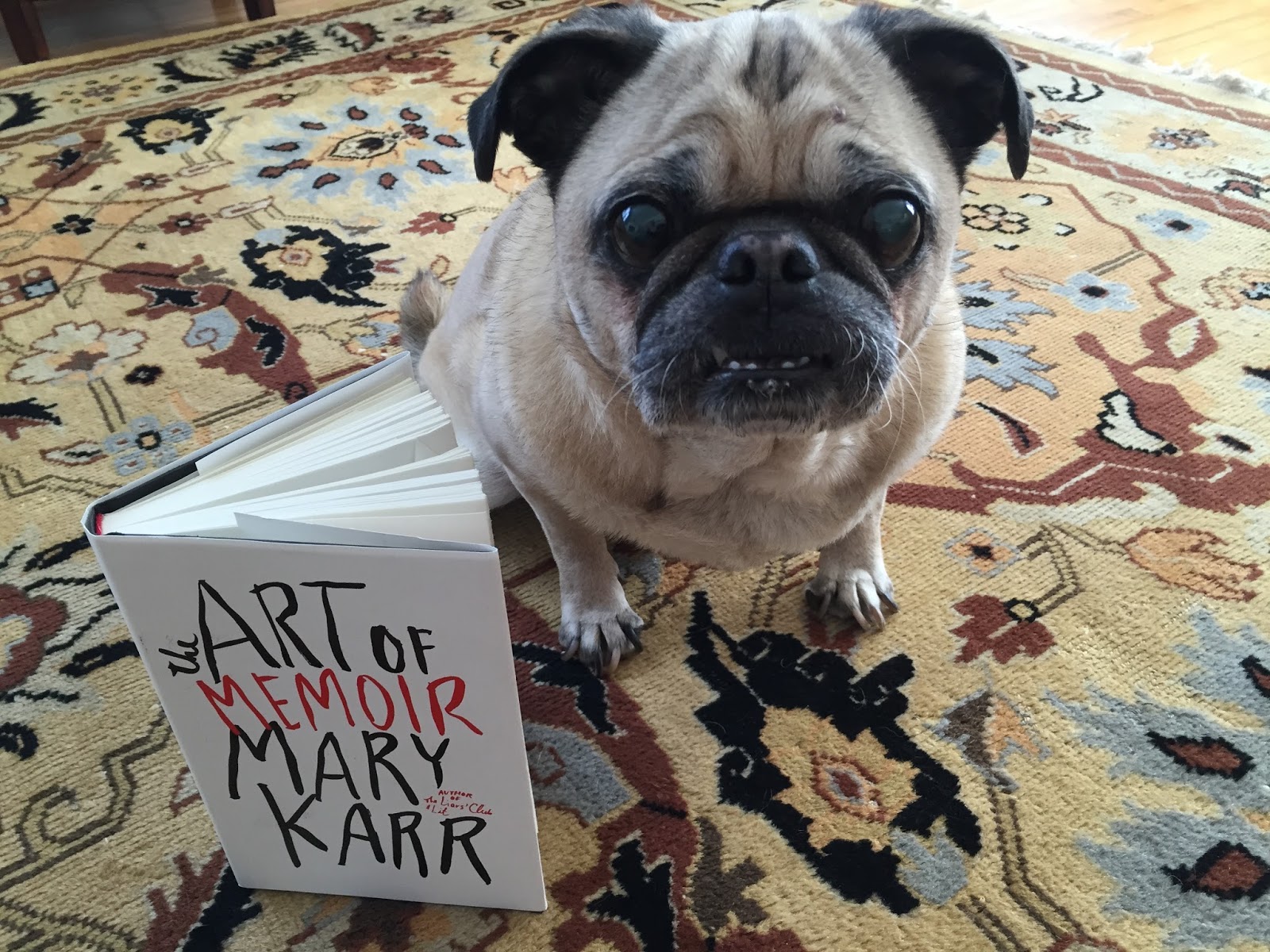
"The Art of Memoir": Why Our Stories Matter


"To bring oneself to others makes the whole planet less lonely.  The nobility of everybody trying boggles the mind." - Mary Karr

I've taken over a month off from my book blog.  I realized today that I miss writing, and opted to shirk the laundry piling up, the planning I need to do for my yoga classes, and the work that I need to complete for Stageoflife.com and to get back to writing.

I've read 5 books since I last posted, so there may be a deluge of book blog posts over the next 2 weeks.  Although I usually write my posts in the order I read books, I want to start with my favorite book that I read which was recommended to me by my best friend and one of our editors, "The Art of Memoir" by Mary Karr.

Oddly, I have never read any of Mary Karr's other books even though memoir is my favorite genre.  I owned "Lit" but gave it away right before we moved in Illinois. I remembered trying to start it once and not being able to get into it, so I carelessly tossed it into the "give away" box.  "The Liar's Club" was always on my list of "to reads" but I always found other memoirs to read before I purchased it.  After finishing her book "The Art of Memoir" and hearing her stories, being engaged by her voice, finding her vast knowledge of memoir writing awe inspiring, and feeling the tug to write more because of her book, I know that I need to read her memoirs to get to know her story even better.

As I often do before I post my own thoughts about a book, I check out what the "big guys" have to say about them.  "The Art of Memoir" received mixed reviews.  It made a few "best books of 2015" lists including Amazon's best book of September 2015, but it also got some reviews that called it "muddled" or "boring." In the New York Times Sunday Book Review, Gregory Cowels wrote, "It is not, alas, a very good book. Repetitive, unorganized, unsure of its audience or tone, it can’t decide whether it wants to be a how-to guide or a work of critical analysis." Yikes.  I agree with him that sometimes that book is messy, but so is life, right? Isn't that the strength of a good memoir, to make some sense out of the mess of life? Karr writes, "But I still feel awe for us - yes, for the masters who wrought lasting beauty from their hard lives, but for the rest of us, too, for the great courage all of us show in trying to wring some truth from the godawful mess of a single life." To me the mark of a good memoir is exactly that, and although I have never read a book about the art of writing memoirs, I do believe that Karr succeeds in finding truth in the process of writing about the truth of living messy lives.  

Drawing on her teaching syllabus, she weaves in and out of her own experiences of memoir writing and the craft of other well known memoir writers to explain what makes great memoirs great and what are the pitfalls of bad memoir writing.  She's not only funny, but she's also smart. Having three of her own best selling memoirs and having the prestige of a professorship at Syracuse University does not make her unapproachable.  Giving practical advice about how to deal with people that you write about in a memoir, and general rules of good writing (use sensory details - she calls them "carnal" details), Karr also includes a chapter called "Hucksters, the Deluded, and Big Fat Liars" basically saying when writers stretch the truth knowingly they suck.  It's way harder to strive to get the truth right and accurate because memories are tricky beasts.

The parts of the book that drew me in the most were Karr's own stories of writing attempts and failures as well as her victories.  She admits to not being the best writer, but being a "bull dog" of a revisionist searching for the best and most authentic details.  She discloses that she often had to write the wrong thing in order to clear the path to write the right thing.

What I loved best about this book is that it transcended writing memoirs and to me, was more about the search for our authentic selves.  When she asks questions like, "And most of all, how am I afraid of appearing? Go beyond looking bad or good. Is there posturing or self-consciousness you could duct or correct or confess and make use of?" These questions are about constructing identity, and revealing our authentic self by writing our truths in the best way that we can.  Why do people write? To tell the truth? To understand the truth? To get to the truth? Sometimes we need to write our past to make sense of what happened in order to be able to move on in the present. Sometimes we are lucky enough to connect with other people who benefit from our struggles - either the struggle of writing or the struggles that we lived to tell about in our stories.

This book isn't for everyone.  Some chapters delve heavily into to literary analysis of the memoir greats like Maxine Hong Kingston and Vladimir Nabokov.  The English teacher in me loved these chapters, but I can't see all readers enjoying them.  I, on the other hand, love people who are passionate about good writing and can see the craft of other writers as a gift.

My biggest take away after reading this book was to rekindle my writing self and to find my voice again on the page.  Sometimes I get so caught up in the minutia of life that I forget about this writer inside of me who wants to do more than just read books and post about them.  Karr helped me fall in love with writing again and see the beauty in the elusive craft of telling our stories authentically and truthfully.


Monday, October 26, 2015

"Devil in the White City": Pure Evil and Pure Triumph at Chicago's 1893 World's Fair


Make no little plans; they have no magic to stir men's blood. - 
-Daniel H. Burnham
Director of Works
World's Columbian Exposition

I lost count of the number of people who recommended that I read Erik Larson's "The Devil in the White City"(2003) over the last 12 years.  That number increased when I told people I was moving outside of Chicago.  Even the woman who worked at Tumble Town in the York Galleria Mall suggested it to me.  "I would love to go to Chicago and see all the things in that book," she said as I peeled the name tag stickers off of my sweaty girls.  "Everyone in my book club loved it, and most of the time we fight about books," she said as she looked at me intently.  I handed her my credit card as she continued, "I mean, if you are moving out there, you really need to read it." Most of the time friends would reference it and say, "What do you mean you haven't read it?" almost as if they were mad at me for neglecting my duties as an avid reader.

When we moved to Crystal Lake, my cousin who lives in Chicago visited us and brought her copy of "The Devil in the White City" with her and dropped it off at my house. She repeated the same thing everyone else who has read it said, "You'll love it.  It's really amazing, and now that you live near Chicago, it's a must read."

Still I was unswayed to pick it up immediately.  I thumbed through and noticed that the words inside were really small and it looked rather long.  And non-fiction history isn't really my favorite thing to read.

I put it on a shelf and proceeded to read many other books.  Then, one day, I was passing by my bookshelf and the cover of "The Devil in the White City" was facing me, and I decided that it was time.

The subtitle of this book is "Murder, Magic, and Madness at the Fair That Changed America" and murder, magic and madness take center stage throughout the book. Larson's book tells two stories that are equally compelling in flip flopping chapters.  With one story he recounts Chicago's improbable journey of winning the bid for the 1893 Columbian World Fair and the treacherous road that the architects and landscape artists traveled in order to showcase a fair such as the world had never seen.  The second story tells the tale of the twisted Dr. H. H. Holmes who constructed his own house of murderous horrors and turned it into a hotel during the World's Fair in order to trap and kill unsuspecting prey.

Although through the first 40 pages or so names and places overwhelmed me, both stories quickly gathered steam and I was drawn into the mayhem of both.  Larson used his stellar research to weave two equally sensational historical oddities together, and I loved every detail in both story lines.  I never tired of all the set backs due to weather or the naysayers who repeated "it's never been done before" or the constraints of the budget or the unions who were against the fair's progress.  I loved every fact about nails and bolts equally as much as I marveled that Ferris was able to achieve something no one had ever seen before with his towering rotating wheel.  At the same time, I was horrified by the gruesome accounts of the seductive and cunning Dr. Holmes who carefully chose his victims and then disposed of bodies in chemicals and his high temperature basement furnace. His murderous spree went undetected largely in part due to the distraction of the World's Fair.

But it wasn't only Larson's impeccable research that made this book so amazing.  He was also able to construct both story lines into nail biting narratives that read more like a novel than a fact based history book.  During certain parts I wanted to stand up and applaud Larson's writing prowess and his ability to keep me turning pages.

I also gained new respect for the city of Chicago and the amazing progress that the 1893 World's Fair brought with it.  From actualizing an urban landscape that is beautiful and technologically advanced, to improved sanitation efforts, to making cities a place that people want to visit, to beating impossible odds, Chicago proved to be both an unforgiving landscape for the Fair as much as it was the best location ever for a fair.

Because Larson's book reads more like a novel than a non-fiction book, I raced to get to the conclusion.  What happened to Holmes? I had to know, so I shut out the world and read on.  What other pressures would the World's Fair face? I couldn't wait to find out how each obstacle surfaced and how the builders and planners forged onward.

Everyone who urged me to read this book was right.  It was an incredible book, and I can't wait to visit downtown Chicago and see it with new eyes.  Not only that, I recently learned that the movie version starring Leonardo DiCaprio and directed by Martin Scorsese will be released soon. I promise not to wait 12 years to see it.


Thursday, October 8, 2015

"Rising Strong:" Just Go Out and Buy It


"The opposite of recognizing that we're feeling something is denying our emotions.  The opposite of being curious is disengaging.  When we deny our stories and disengage from tough emotions, they don't go away; instead, they own us, they define us.  Our job is not to deny the story, but to defy the ending - to rise strong, recognize our story, and rumble with the truth until we get to a place where we think, Yes. This is what happened.  This is my truth.  And I will choose how the story ends."
- Brene Brown

I used to buy every single book that I wanted to read, but then I realized that
#1) Books take up a bunch of space
#2) Books are heavy when you need to move and movers charge by the weight of your stuff
#3) Not all books are worthy of keeping after you have read them
#4) Books are expensive
#5) Although many people love to read from their devices, I still love the solid feel of a book in my hands (which brings me back to numbers 1-4)

In the past few years I've been way more of a library junkie, making sure to put holds on all the books that I would like to read.  When I saw that Brene Brown released a new book called "Rising Strong" I decided to purchase it instead of waiting for it to come in at the library. Brene Brown's Ted Talk on the power of vulnerability is one of my favorites because it really made me think about how I constantly need to show everyone how strong I am rather than allowing myself to appear vulnerable.  I also really enjoyed reading her book "The Gifts of Imperfection" (my wonderful friend, Nikki sent it to me right after I moved).  That book allowed me to ease into my move without feeling overwhelmed by perfectionism that can sometimes cripple me.

Not only do I not regret this purchase, I am encouraging others to go out and buy Brene Brown's new book, "Rising Strong: The Reckoning. The Rumble. The Revolution."  I've actually recommended it to so many others and several of them are reading it and loving it. Why? Because there are so many take aways from this book, that it's one that you will want to come back to when you are struggling through conflicts, work drama, family issues, or just trying to own the story of your life.

I actually annotated as I was reading (which prompted raised eyebrows from both of my daughters who have had it drilled into their heads at school that you NEVER PUT MARKS IN BOOKS.  They asked me with strained voices, "Mommy, why are you writing in your brand new book?!").  I told them I would never write in a library book, but this book was mine and there were things that I wanted to remember and if I took notes in the book as I read, I could easily find them again.

I underlined and annotated more things than I can effectively share in this post, but I will tell you some of my biggest take aways.  My first take away is from Brene Brown's story about meeting the Pixar creative team.  During their meeting and subsequent correspondences, she realized that the struggles we all face are very similar to the creative process of creating a story and the struggle that the story writers and animators face. When a creative team maps out a story they follow the steps of a hero's journey or archetypal theory; they see this as three acts to the story.  It's Act 2 that the creative team struggles with the most.  This is the act where the hero has to reach rock bottom, the lowest of the low point, before he or she can rise and achieve redemption.  Applied to real life, act two is where many people don't dare touch because it is messy, it's complicated, it's emotional and it's where we are at our most vulnerable.  Let's face it, most people don't enjoy being uncomfortable.

Brene Brown's take away from this is that we need to rumble through this messy Act Two phase in order to rise strong as we create the stories in our lives.  She realized that story is an integral part of our vulnerability.

For me, this was a big point of wisdom because I do believe that telling our life stories honestly and being able to share them makes us not only vulnerable, but helps us to connect with others. That's why our tag line at stageoflife.com is "changing the world one story at a time." Our stories humanize and connect us, and the more vulnerable we are willing to become in sharing our story, the greater human connections we will make.  In Brene Brown's book she wisely says, "The irony is that we attempt to disown our difficult stories to appear more whole ore more acceptable, but our wholeness - even our wholeheartedness - actually depend on the integration of all of our experiences, including the falls."

She encourages us to own our stories, and shares her own stories of conflict in her relationships as examples to show how the process works.  Through examples from misunderstandings with her husband, to professional missteps, to how to handle miscommunication in meetings, Brene Brown's greatest asset is her ability to make everything clear and connected.  She uses references from Anne Lamott's book "Bird by Bird" and her concept of a "shitty first draft" (SFD) and how we often get caught up in the story that we tell ourselves about a situation.  Being able to say "The story I am making up about this situation is . . . " puts things into perspective.  We honestly don't know all the angles of a situation or conflict.  We only know our own story, so if we can own the story that we are telling ourselves and even be vulnerable enough to share our own insecurities with others, we may be able to rise strong through  the rumble in act two rather than let it control us.

Pretty cool, right?

As I read this book (which is a really fast read), I shared the parts I underlined with my husband every night.  He could apply everything to his own situations at work and told me that as soon as I was done that he wanted to read it.  "Rising Strong" is a book that you will want to pass along to others, because it just makes sense.  


Wednesday, January 7, 2015

"The Power of Habit": A Fitting book for New Year's Resolutions


Do you make New Year's Resolutions every year and give up after a week or a month? Maybe you need to take a closer look at the habits that surround your resolution - study your cue, the routine and the reward. Then, dig even deeper into what makes you crave a certain habit.  New York Times investigative reporter Charles Duhigg's book "The Power of Habit: Why We Do What We Do in Life and Business" explores the truth behind habits - the habit loop, our cravings, how we can change habits and how habits can lead us to success or failure as individuals and even societies.  He could end up helping you transform your life (or stick to your New Year's Resolution) by understanding why you do what you do.

Duhigg says this in his introduction:
"In the past decade, our understanding of the neurology and psychology of habits and the way patterns work within our lives, societies, and organizations has expanded in ways we couldn't have imagined fifty years ago.  We now know why habits emerge, how to break them into parts and rebuild them to our specifications.  We understand how to make people eat less, exercise more, work more efficiently, and live healthier lives.  Transforming a habit isn't necessarily easy or quick.  It isn't always simple.
But it is possible. And now we understand how."

I found parts of this book fascinating, parts a stretch of comparisons that didn't necessarily fit together, and then others more about mob psychology and societal change than habits themselves.  Regardless of the slow parts or the parts that made me scratch my head a bit (in one section he compared a gambling habit where a woman gambled away her life savings to a sleepwalking habit of a man who accidentally killed his wife), the rest of the book was compelling enough for me to read sections aloud to my husband who is tasked with transforming his growing company.  I kept asking him, "Have you ever thought about that for your company?" He listened intently.

As I read about Hopkins transforming the dental hygiene of Americans by creating a foaming craving and tingling sensation in Pepsodent toothpaste, I was intrigued.  This was a necessary habit to stop the epidemic of bad teeth.  As the government put it when they started drafting men for WWI "so many recruits had rotting teeth that officials said that poor dental hygiene was a national security risk." Look at us now - consumed by foaming and tingling sensations brought about by whitening toothpastes.  The choices in the toothpaste aisle are dizzying thanks to the habits Claude Hopkins helped to create in the early 1900s. What would our teeth look like today if Hopkins had not helped us create that habit?

Another part of the book that was fascinating to me was Paul O'Neill and his ingenious reformation of ALCOA.  Unlike the previous CEO, O'Neill stepped into power and made one thing his goal - safety.  By changing the way people thought about safety, he improved every aspect of the company.  He improved their profits, and higher quality products.  Researchers have found that tapping into the right keystone habit can transform other habits.  For example, "studies have documented that families who habitually eat dinner together seem to raise children with better homework skills, higher grades, greater emotional control, and more confidence." Just like they have found that people who habitually make their beds are more productive and better with sticking to a budget.  "It's not that a family meal or a tidy bed causes better grades or less frivolous spending. But somehow those initial shifts start chain reactions that help other good habits take hold." Eye opening stuff.

When he uncovered the secret behind the success of Febreeze, the buying habits of Target shoppers and Target's marketing analysts (totally Big Brother stuff), Michael Phelps and his routine of success, and Tony Dungy's winning coaching strategies that all focus on the habits of players, I again was fascinated by how humans can be broken down to a series of routines and reactions.  Just like when I read the part about recovery from surgery or success according to Starbucks stems from creating a habit - a habit of how to help someone in stressful retail situations (LATTE is ingenious) or a habit of writing down an intention.

I somewhere read that a study showed that students who attended Harvard business school and wrote down their goals were more successful than students who didn't which makes perfect sense according to Duhigg's research.  I also like to think that my husband and I are more successful in reaching our goals because we meticulously write them down and try to come up with one intention for the year.  Last year my intention had to do with a successful cross country move for me and my family, and things worked out really well.  This year my focus is on creating more of a balance in my life.  Am I working on my habits the right way? I'm not so sure about that, but I am way more aware of the psychology behind successful and not so successful habits thanks to reading this book.

Duhigg's book will stick with me for some time to come (and many more New Year's Resolutions to come as well).


Wednesday, October 8, 2014

"My Accidental Jihad": The Complex Journey of the Marriage of Two Cultures

“According to Ismail, the prophet Muhammad taught that the greatest jihad, or struggle, of our lives is not the one that takes place on the battlefield but the one that takes place within our hearts - the struggle, as I understood it, to manifest humility, wisdom, and compassion. Ramadan threw me into my own accidental jihad, forcing me to wrestle with my intolerance and self-absorption. And I had been losing ground in this battle, forgetting my husband’s intentions and focusing instead on the petty ways I was inconvenienced by his practice.”

When aspiring journalist, Krista Bremer, turned in her California surfing lifestyle where the next wave took precedence over material wealth or job security, for an educational opportunity in North Carolina, she had no idea that she'd meet her future husband while doing her daily run.  She had no idea that her future husband would be way older than her, have yellowing teeth, nor that he would be a Libyan.

In Bremer's memoir, "My Accidental Jihad", she uncovers what those of us who are married already understand - marriage is hard work.  But, the work that Bremer and her husband, Ismail, encounter possesses it's own complications based on faith (he's Islamic, she's a non practicing Christian) and culture (he haggles over the price of a wedding ring, she just wants to pay what the salesperson asks and is mortified that her husband would even consider arguing the price).

The power in the book stemmed from Bremer's internal grappling with what she loved about Ismail (he is a warm place for her that she didn't know she needed), and what she can't understand or tolerate about him (his need to strictly follow Ramadan restrictive practices which she calls "Ramathon" or his insistence on living on what we need rather than living in excess).

Their accidental love story begins with a love of running on the trails around Chapel Hill, North Carolina and a coincidental meeting at a market where he shows her how amazing fresh tomatoes can be.  They hook up even though he is everything that she never wanted.  He lives in a sparsely furnished attic apartment with meager possessions.  He seems to love cleaning the counters.  He's much older than she is (and he even has, gasp, wrinkles which are taboo in the California landscape she's used to which worships at the alter of youth and false appearances).  After Bremer accidentally gets pregnant, they decide to get married on purpose and begin the precarious balancing act of starting a life together as two relative strangers who know little about each other's histories, dreams and desires.

She traverses the marriage missteps, but is always able to eventually see things from Ismail's perspective like when they are on a used car lot because she no longer wants to be embarrassed by his 1987 Toyota.  Giving into Krista's demands to get a new car, he tells her that all the cars are the same to him.  To her, there was a difference between a shiny new car and a 1987 Toyota.  She reasons, “In that instant, I glimpsed the lifelong challenge of our marriage: I assumed we saw the same thing when we observed the world, but our interpretations of what we were looking at would never be the same.”

At times Bremer's overflowing, flowery language was a bit much. Like when she described her pregnancy nightmares: "At night I dreamed of the taut skin of my belly tearing like tissue paper against the weight of this somersaulting body, of frantically tucking tiny limbs back inside as hot blood spilled through slippery fingers." At other times, she doesn't give enough information about Ismail's history (maybe she doesn't know it?) or about his present situation. He comes off sounding more like an Americanize peasant rather than an older, sophisticated, PhD student who lives simply. She sometimes goes for an easy victory of how Ismail's view of the world and his culture with it's emphasis on family raising, spiritual fulfillment, and an aversion to material possessions are infinitely better than the "thing crazed," lack of faith, selfish, workaholic Americans.

Even with the chronological leaps, the story of Ismail and Krista sustained my interest and even invoked a few tears. Who hasn't had marital strife or communication problems with their spouse who at times feels like a foreigner? Who hasn't questioned the in-law's practices or cringed at the thought of being left alone at a dinner table while the in-law relatives spoke in what seemed like a foreign language? The only difference here is that Krista really did marry a man from a different culture which becomes painfully clear when they travel to Libya to meet Ismail's family. They bring their 5 year old daughter, Aliya, along on the trip, and Krista deals with the language barrier, culture barrier and with her early pregnancy pains as well.

Marriage can often be a wrestling match of intolerance of the other's point of view or self-absorption. It's a precarious balancing act to love the differences between us and our partners and not let them tear us apart. Bremer's book "My Accidental Jihad" shows that marriages between even the most dissimilar people can work when they treat each other with respect, and celebrate rather than vilify the differences between them with humility, wisdom and compassion. That's the real magic behind marriages and love stories that last.


Thursday, July 3, 2014

"The Gifts of Imperfection": A life guide


"How much we know and understand ourselves is critically important, but there is something that is even more essential to living a Wholehearted life: loving ourselves." - Brene Brown

Brene Brown's Ted Talk is one of my favorites of all time.  Her quality to allow people to feel deeply and take a hard look at the way they live their lives inspires me.  Researching predominately in the areas of shame and vulnerability helps her to guide people to a "Wholehearted Living" revolution. She defines wholehearted living as living with courage, compassion, connection, and deliberate boundaries. Her book "The Gifts of Imperfection: Let Go of Who You Think You're Supposed to Be and Embrace Who You Are" serves as a guide to wholehearted living and can truly change the way people view themselves and their lives.

Right when I moved to Crystal Lake, one of my very dear friends had a package waiting for me to welcome me to my new home.  Inside she had bubble bath, some tea, a cute towel and the book "The Gifts of Imperfection."  I cried a little when I got the package.  Moving is overwhelming; the most overwhelming part is how much new there is every single day.  New is great and change is important, but getting a wonderful package from home from someone who truly knows my soul made my whole week feel more normal.  My friend's package was another reminder for me to stay open and know that I will find exactly what I need, exactly when I need it if I give myself a break.

Giving myself a break is sometimes easier said than done.  My husband and I are the types of people who want to have everything completed RIGHT NOW, but after a major move to a new state where we know virtually no one, we are learning patience. Patience with home renovations. Patience with finding places. Patience with our daughters' see-sawing emotions as they transition away from everything they know into this new space, and most of all patience with ourselves.  Brene Brown's book helped me to love myself even more through our new life beginning here and recognize that loving myself is the key to success through this journey of change.

Each chapter of her book leads the reader through a series of guideposts (Letting go of what people think, letting go of perfectionism, letting go of numbing and powerlessness, letting go of scarcity and fear of the dark, letting go of the need for certainty, letting go of comparison, letting go of exhaustion as a status symbol and productivity as self-worth, letting go of anxiety as a lifestyle, letting go of self-doubt and "supposed to," letting go of being cool and "always in control"). The guidepost titles themselves were enough to motivate me, but Brown's soothing tones and down to earth approach on each of the topics through her life stories helped put everything in perspective for me especially during this huge time of transition in my life.

I don't need to be certain and being vulnerable in this new space is a given, but after reading Brown's lessons, I feel that I can give myself permission to be imperfect like when I tripped and almost did a face plant at the splash pad while trying to retrieve my 5 year old from the too high monkey bars, or when I accidentally hit the bumper of a car in the parking lot as I adjusted my GPS on my dashboard and tried to talk to my daughter at the same time.  All this new takes focus, and I am constantly reminded that I need to concentrate to achieve that focus.

There are bound to be missteps, but I feel like Brown's book gave me even more tools to join the wholehearted revolution.  I might not be perfect, but I am proud of who I am and even prouder of the person that I am becoming.

Each night as we sit down to our family dinner, my daughters, my husband and I all say our "charm" for the day ("charm" was a term that our daughter, Story, came up with when she was 3.  It means to say what you are thankful for from the day). My charms come so rapidly since we have moved to this new community.  I have so much to be grateful for - a beautiful new home, my amazing and quirky little family, friends who send me packages from home, my health, being surrounded by love and for new experiences and opportunities. Most of all I am thankful that I am beautifully imperfect and able to embrace myself exactly as I am.


Tuesday, June 24, 2014

"10% Happier": Meditation 101


It's been awhile since I've been able to write (so this will be a long entry), because my life has become a chaotic blend of boxes, upheaval, packing, unpacking, letting go, moving on and reentering in a new location.  People move across the country every day, but no one ever really talks about the physical and mental toll that it takes to do it.  Brene Brown included moving as one of the one of the "great unraveling journeys" in her book "The Gifts of Imperfection" (which I am currently reading).

Somehow through my "great unraveling journey" from our home in Pennsylvania to our new one in Illinois, I have kept a mantra in mind: "I am exactly what I need, exactly when I need it."  Through our epic moving adventure, that mantra has worked beautifully.  We put our house up for sale and got two great offers within the first 48 hours it was on the market.  We found a new home in our new location on the street that we wanted in less than 24 hours.  We made it through the appraisals and inspections, the loans and approvals, the paperwork and the legalities unscathed.  Even our cross country trip with our 10 year old pug who hates cars, our 14 year old cat who hasn't been out of our house in 12 years, our 9 year old daughter, and our 5 year old daughter went well.  We only hit traffic in Chicago the whole 12 hour journey.

So here we are.  In a new home.  In a new neighborhood.  Everything is new.  Everything is possible.  It's scary and exciting.  Frustrating and wonderful.

With each new moment (today I was so proud to find my new grocery store!) I keep my "I am exactly what I need, exactly when I need it" mantra in the back of my head.  I think of all the "self help" books I have read or books like "The Alchemist" that teach when you are open to the universe, the universe opens up to you. That's how I feel about Dan Harris's book "10% Happier." I needed to read a book about someone else's journey to find their calm center in a world of chaos and uncertainty.  It helped as I went through my own "unraveling" by giving me hope that if I just stayed focused and open to the universe that I would be okay.

Dan Harris wrote his book "10% Happier" to explain his experiences and spiritual journey to daily meditation.  Harris co-anchors "Nightline" and the weekend edition of "Good Morning America." After deeming the voice in his head "an asshole" he decided to find out how to get more centered and stumbled into the realm of meditation which he believed was everything that he hated - sitting still, being calm, being present, and even occasionally chanting surrounded by people that smell like feet.  His years of covering various extremist religions left him skeptical about anything remotely spiritual, so his journey really speaks to the every day person who is fed up with feeling stressed all the time but doesn't know what to do about it.

I loved this book from the very beginning.  I thought Harris's narrative of his early news anchor frenetic days and his out of control substance abuse, his journey to spirituality all rang true and pure.  He showed me reasons why meditation works and reasons why he and many others doubt the validity of meditating, but how the tides are turning.  I also loved that he offered practical advice for those just starting out with meditation (there is a nice guide to meditation for beginners in the back of the book).  Mostly, I loved how he met the gurus along the way like Eckhart Tolle and how he explains their philosophies on life and meditation.

I needed this book to help guide me through my "great unraveling journey" and direct me to a calmer place.  When Harris attends a Joseph Goldstein meditation retreat, his thoughts on the days spent in quite meditation really resonated with me especially when he raised his hand and asked how to not worry about things since there are genuine things to worry about like missing planes.  Goldstein answers, "But when you find yourself running through your trip to the airport for the seventeenth time, perhaps ask yourself the following question: 'Is this useful'?"

During my moving journey, I continually asked myself that question.  Is it useful to worry about my buyer's buyer's loan? Is it useful to worry about whether or not we will make our closing date in our new home? Is it useful to worry about how my animals will react to a long car ride? Every time I answer the same thing: It is not useful to worry.  I still worry, but now I remind myself that it isn't useful to do it.

I mostly love that Harris doesn't propose that meditation is the answer to happiness.  He claims in his own life that it has made him 10% happier which is a great percentage.  Who doesn't want to be 10% happier?

I know I do.


Tuesday, March 18, 2014

'Quiet: The Power of Introverts in a World That Can't Stop Talking': Validation for the Less Vocal


Power is not a word usually associated with introversion.

I've lived most of my life as an extrovert even though I am an introvert, and although I feel powerful and confident, my introverted side often makes me feel less than powerful.  I surround myself with extroverts - my husband, my two daughters, and my two best friends.  And I don't think that most people, especially my past students, would ever think I was an introvert.  A few years ago, a student wrote me a letter at the end of the school year that said, "At first you annoyed me because you never stopped talking, but I realized somewhere along the way that you were an amazing and caring teacher and I really loved your class, so thank you."  It's not the first time I was told that I talk too much, which is ironic since throughout my life I've basically forced myself to not be so quiet in large groups.

I remember times in high school and college that I felt like I was choking to find words to share in class.  I worried about my face turning red, that my words didn't come as quickly as the people around me whose hands flew up as soon as the teacher posed a question. I once skipped a school day because I didn't want to give a speech. Not to mention the slew of other introverted traits I possess - I'm sensitive to my environment both emotionally and physically.  I prefer to hang out with one other person.  I am not a pack animal.  I prefer a quiet dinner over a loud party. I like to work alone. Being "on" all day as a teacher exhausted me. I am rejuvenated through yoga and reading and taking long walks by myself. I prefer to think before responding. Finally,  I don't like to be in the spotlight even though I have been in high school plays and musicals, been the leader in numerous activities and committees, been a camp counselor, a high school English teacher, the singer in a band, and a hostess with the mostess.

I prefer to be quiet because life feels loud to me often.  Even while I was living in London, my favorite days were spent in museums or taking walks by myself in new parts of the city.  I loved hopping on the train by myself and going to a new country to figure it out alone and spending the afternoons writing in a cafe.  The idea of traveling in a group made me more nervous than navigating a foreign city alone.

Susan Cain's book 'Quiet' helped me to validate my introverted power and make me think deeply about my core personality, but even better it helped me to appreciate the parts about me that most often I associate with some negative feelings. As Cain puts it in her introduction, "It makes sense that so many introverts hide even from themselves. We live in a value system that I call the Extrovert Ideal - the omnipresent belief that the ideal self is gregarious, alpha, and comfortable in the spotlight." So many times in my life, I have apologized either to myself or to others about something that stemmed from my introversion.

Cain starts 'Quiet' with how extroversion became our cultural ideal and when our society started to value the doers and talkers with big personalities versus the Eastern ideal of the wise leaders who spoke little and meditated often.  Cain gathered research on the introverted leaders that our country needed to propel itself forward, and those that shaped the culture we live in - from Lincoln to Martin Luther King, Jr., from Rosa Parks to J.K. Rowling, from Einstein to Spielberg. As I read example after example and felt more and more validated about being an introvert, I thought that she missed the point that not all introverts are being overlooked in our society and in many professions the introverts are sought out - maybe not in the business world or in education, but in many places introverts shine even brighter than extroverts. She is sometimes harsh with her research and examples of the over impulsive, extroverted leaders who feed only their egos without really ever thinking about the financial ruin they will inevitably unleash on the country.

When I shared some of the parts of the book with my very extroverted husband like the Harvard Business School model which leans heavily on students working together and extroverts leading the way or the part about Tony Robbins and his leadership retreats, my husband said, "Did she say anything good about extroverts?" I thought about this as I read.  I came to this conclusion - it wasn't really that Cain made the point that introverts are better than extroverts, it was more that as a society we seem only to value the extrovert in leadership positions and in our education system and even in the way we parent.  We view introversion as something we need to fix; we feel the need to bring introverts out of their shells and open them up as if converting them into extroverts will make them normal.

Cain's research made me think about my own teaching style.  I am an introvert who ran a very extroverted classroom.  I did make it my goal to help the quiet kids speak, giving them opportunities to be heard drawing from my own experiences as the quiet one that had great ideas but didn't know how to share them effectively.  Why did I feel the need to fix them?

The stories Cain shared about brilliant Professor Brian Little who lectured and dedicated himself to his students in the most extroverted way possible, so much so that none of his students would ever guess that after giving speeches at conferences that Little, a very introverted man,  would hide in the bathroom stall to avoid more talking during lunch.  I've done this.  During my last year of teaching, one of my favorite times during the day was my 30 minute lunch break where I ate alone in my classroom.  I was able to recharge and reset myself to be extroverted for the rest of my students for the rest of my day. This is what Cain calls a "restorative niche" - the place you want to go to "return to your true self."

'Quiet' opened my eyes to how lopsided our culture is in terms of the "Extrovert Ideal." Cain doesn't try to make the point that we all need to be introverts, but she does produce compelling evidence (her depth and variety of research studies include adults, leadership, children and relationships) that our society often tries to encourage everyone to be extroverts and rather than changing our core personalities, introverts need to have a "quiet revolution" and revel in the gifts they possess.

I know that after reading the book and clicking together the pieces of my life, the tension spots in my marriage, the times I felt my most comfortable and most uncomfortable, that many of those pieces coincided with my introversion.  I may not be starting a quiet revolution, but I at least feel validated for the powerful person that I am because of my introverted core personality.